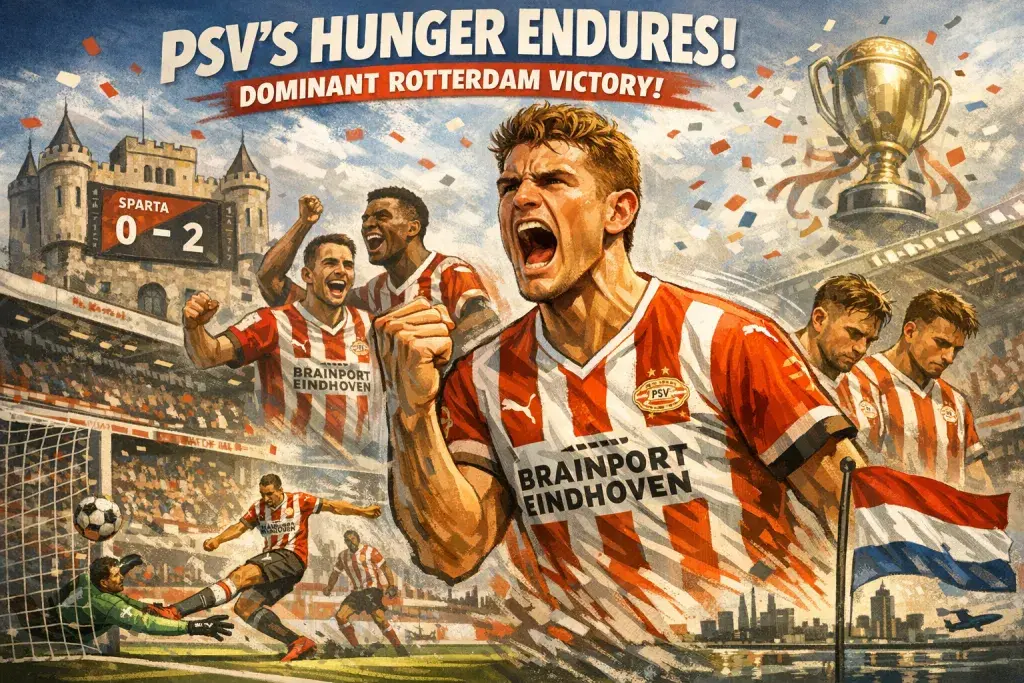
Winning a title ahead of schedule creates a particular kind of psychological test — one that most groups of competitors fail. PSV Eindhoven passed it convincingly on Sunday, defeating Sparta Rotterdam 2-0 at Het Kasteel in a performance that left little doubt about the club's continued ambition. Midfielder Guus Til was among the standout performers, and his words after the final whistle carried as much weight as the result itself.
Motivation That Outlasts the Celebration
Early success has a well-documented tendency to erode intensity. When the primary objective is achieved with weeks still remaining, the psychological contract that binds a group together can quietly dissolve. What made PSV's display in Rotterdam notable was the absence of that familiar drift. Til addressed the dynamic plainly: "Speaking for myself, I wanted to step up a gear and show that we are the best." That framing — not maintenance, but escalation — signals something beyond professional obligation.
Til described the early title as an opportunity rather than a finish line. "When you're champions this early, you can celebrate every week. I just want to win everything." It is a deceptively simple statement, but one that reflects a competitive psychology difficult to manufacture artificially. For the individuals within the group, the extrinsic pressure of a title race has been replaced by an intrinsic one — the desire to validate quality through continued performance.
Depth Tested, Depth Confirmed
PSV were without two key figures in midfield — Joey Veerman and Jerdy Schouten — yet the replacements integrated without disruption. Til acknowledged the quality Veerman brings, particularly his ability to deliver precise long passes over the defensive line, while being equally clear that those who deputised met the same standard. "The guys who came in today were also very good," he said.
This kind of depth is not accidental. It reflects sustained investment in squad construction and a training environment that maintains readiness across the entire group, not just among the established names. When replacements perform without a visible drop in quality, it speaks to the coherence of the collective rather than the talent of any individual. PSV's performance in Rotterdam offered evidence of exactly that coherence.
A Performance That Demanded More of Itself
Despite the comfortable final result, Til was candid about what he felt the occasion deserved. "We didn't get into trouble and should have been 3–0 up at half-time." That kind of self-assessment — a winning side measuring itself against its own potential rather than the opposition's resistance — is the hallmark of a group with high internal standards. An early goal was disallowed due to a handball in the build-up, a decision Til accepted with pragmatism. "I thought someone else had touched the ball at first, but I understand the call," he said.
The episode illustrated something important: composure in the face of marginal decisions, no frustration, no collapse of concentration. The group moved forward. That composure under low-stakes conditions is, in many respects, harder to sustain than composure under pressure.
An Eye on the Horizon: National Duty and the World Cup
Beyond club matters, Til offered a carefully worded glimpse into his international aspirations. The Dutch national setup has been in contact — he confirmed a call from national team figures, including Veerman — though he declined to share the details. "I do feel there's still a chance to play," he said. With a World Cup on the horizon, such conversations carry real weight for players who have experienced international football but are not yet fixtures in the setup.
For Til, a strong run of performances at club level is the clearest argument he can make. His showing in Rotterdam — influential, composed, technically sharp — was exactly the kind of evidence that national selectors notice. Whether that translates into an Oranje call-up remains to be seen, but the intent is unmistakable. He is not winding down a season. He is building a case.